There are albums that arrive with names, declarations, and a sense of introduction.
And there are albums that simply appear.
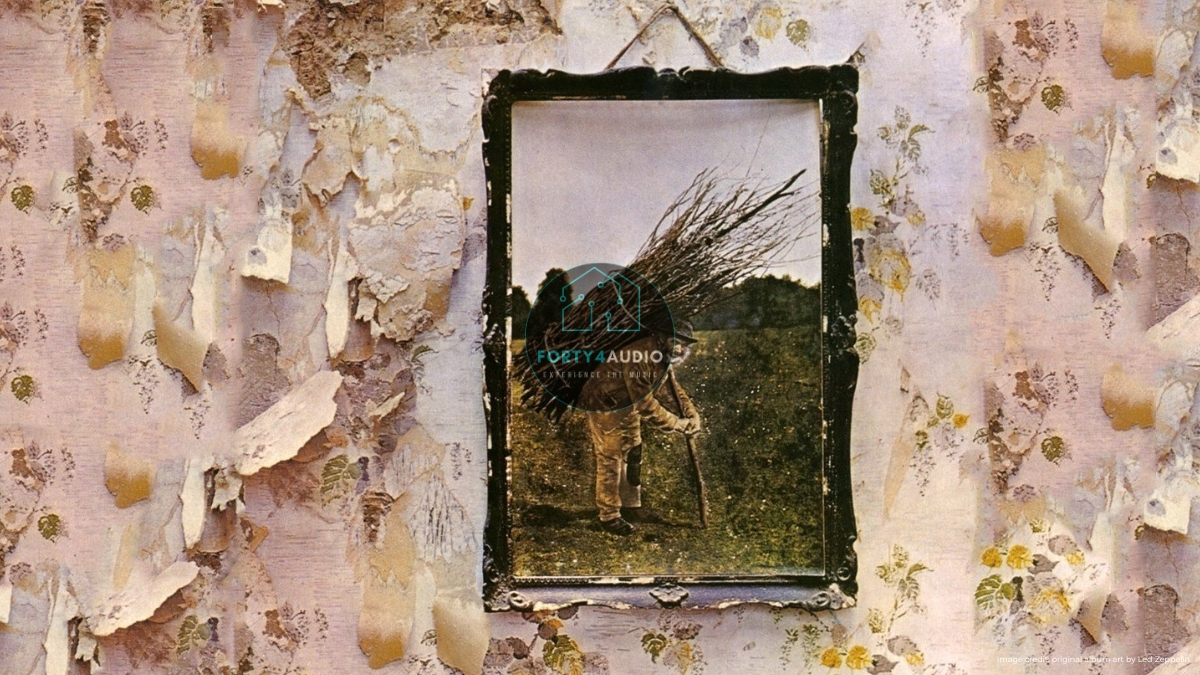
When Led Zeppelin released Led Zeppelin IV in November of 1971, the band removed almost every identifying marker from the cover. No band name. No title. Only four symbols chosen by the four musicians. A weathered image of a man carrying sticks hung on the front sleeve like a fragment of a story whose meaning was left intentionally incomplete.
It felt less like an announcement than an offering.
By that point, Led Zeppelin had already moved through several identities. The first two albums were loud and immediate. Led Zeppelin III stepped toward acoustic space, folk textures, and quieter rooms. Critics were unsure what to do with that shift. Instead of responding with explanation, the band withdrew further into the music itself.
Much of Led Zeppelin IV was recorded at Headley Grange, a country house in Hampshire, England. The building had no traditional studio structure. Mobile recording equipment was brought in by engineer Andy Johns. Rooms echoed. Staircases carried sound upward. Microphones were placed in hallways and corners where resonance lingered.
The album carries those rooms inside it.
Listening now, the record does not feel constructed in a straight line. It moves more like a walk through different doors in the same house.
And the order matters.
The first side opens the front door with almost no hesitation.
“Black Dog” begins with silence, then a sudden vocal line from Robert Plant that feels as if it arrives from somewhere already in motion. The famous call and response between voice and instruments creates space rather than filling it. Each riff from Jimmy Page, John Paul Jones, and John Bonham arrives like a heavy door closing behind the vocal line.
On first listening, the song can feel muscular and immediate. Over time, what stands out more is the shape of the pauses. The band pulls the music away from itself repeatedly, leaving the listener suspended for a moment before the riff returns.
Those small moments of absence become part of the rhythm.
Without much transition, “Rock and Roll” follows.
Where “Black Dog” was structured around tension and release, “Rock and Roll” feels like motion already underway. The opening drum pattern from John Bonham, inspired by an improvised warm up based on Little Richard recordings, pushes the song forward before anything else can settle.
There is joy here, but also a kind of looseness. Ian Stewart adds piano that flickers through the arrangement like light reflecting off chrome. The song moves quickly, barely pausing long enough to examine itself.
Placed second, it feels like the record briefly throwing open the windows.
The shift that follows is one of the album’s quiet turning points.
“The Battle of Evermore” arrives without drums. The air changes immediately. Jimmy Page moves to mandolin, and the song unfolds in a folk language that feels ancient and slightly mysterious. Sandy Denny, the only guest vocalist ever featured on a Led Zeppelin studio album, answers Robert Plant in a dialogue that moves through images of battle, landscape, and myth.
The song carries echoes of British folk traditions and storytelling ballads. The absence of John Bonham’s drums is noticeable, but the space left behind allows the mandolin and voices to move in circles around each other.
Listening closely, it feels like stepping outside the main house into a colder night.
Then comes “Stairway to Heaven.”
The song is often discussed as a single object, removed from the album around it. But hearing it within the sequence of Led Zeppelin IV reveals something quieter.
It begins gently, with John Paul Jones on recorders and Jimmy Page on acoustic guitar. The music unfolds slowly, almost cautiously, building one layer at a time. The arrangement expands with each verse. Electric guitar enters almost unnoticed. The rhythm section gathers behind the vocal lines.
For several minutes, the song is patient.
It feels less like a performance than a gradual assembling of energy.
By the time John Bonham fully arrives and Jimmy Page begins the solo, the song has already traveled a long emotional distance. The closing section does not explode so much as release something that has been forming beneath the surface.
When the final vocal line disappears, the album does something interesting.
It flips the record.
“Misty Mountain Hop” begins the second side with a completely different atmosphere. The song has a grounded groove built around electric piano and bass from John Paul Jones, with John Bonham settling into a steady, almost playful rhythm.
Lyrically, the song reflects a different world entirely. The imagery draws loosely from the 1968 student protests in London’s Hyde Park. But the music feels relaxed, even slightly humorous.
After the long ascent of “Stairway to Heaven,” this track brings the listener back to the street.
It breathes.
“Four Sticks” shifts the mood again. The title comes from John Bonham playing with two drumsticks in each hand during the recording. The rhythm becomes complex and slightly disorienting. Jimmy Page layers electric guitar and dulcimer textures that create an almost hypnotic atmosphere.
The song resists settling into a simple groove.
Instead, it feels like something balancing itself carefully on uneven ground.
That tension dissolves into the next track.
“Going to California” may be the quietest moment on the album. Acoustic guitar and mandolin move gently beneath Robert Plant’s voice. The arrangement leaves wide spaces between phrases. John Paul Jones adds subtle touches that feel more like atmosphere than instrumentation.
The song reflects Led Zeppelin’s growing relationship with California, particularly the musical communities surrounding Los Angeles and Laurel Canyon.
Yet the tone is not triumphant. It feels reflective. Searching.
Listening late at night, the song can feel almost fragile, like a memory that changes slightly each time it returns.
Then the album reaches its final room.
“When the Levee Breaks” closes Led Zeppelin IV with a weight that is difficult to describe fully until it is heard through loud speakers or headphones that allow the sound to expand.
The song is built around a blues originally recorded in 1929 by Memphis Minnie and Kansas Joe McCoy. Led Zeppelin transforms it into something massive and echoing. John Bonham’s drums were recorded in the stairwell of Headley Grange, with microphones placed high above to capture the natural reverberation of the space.
The sound feels enormous.
Each drum strike lingers in the air before the next one arrives.
Robert Plant adds harmonica and a vocal performance that sits deep inside the mix. Jimmy Page processes the guitar through heavy effects, while John Paul Jones anchors the track with bass and synthesizer textures that move beneath everything else like slow water.
The song unfolds deliberately. There is no hurry.
In many ways, it feels like the opposite of the album’s opening tracks. The energy is not explosive but gravitational. Everything seems to sink downward into the rhythm.
By the time the final notes fade, the house that the album built has become quiet again.
And the image on the cover returns to mind.
The old man carrying sticks across his back. A simple, ordinary act. A small piece of labor inside a larger landscape.
The album itself works in a similar way. On the surface it moves between hard rock, folk music, blues reinterpretation, and mythic storytelling. But living with the record over time reveals something more patient beneath those shifts.
The songs are not competing for attention.
They are arranged like rooms connected by hallways.
Some are loud and filled with movement. Others hold silence more carefully. A few feel like places meant to be revisited after the rest of the house has gone still.
And if the record is left to play all the way through again, the opening space before “Black Dog” returns feels slightly different than it did the first time.