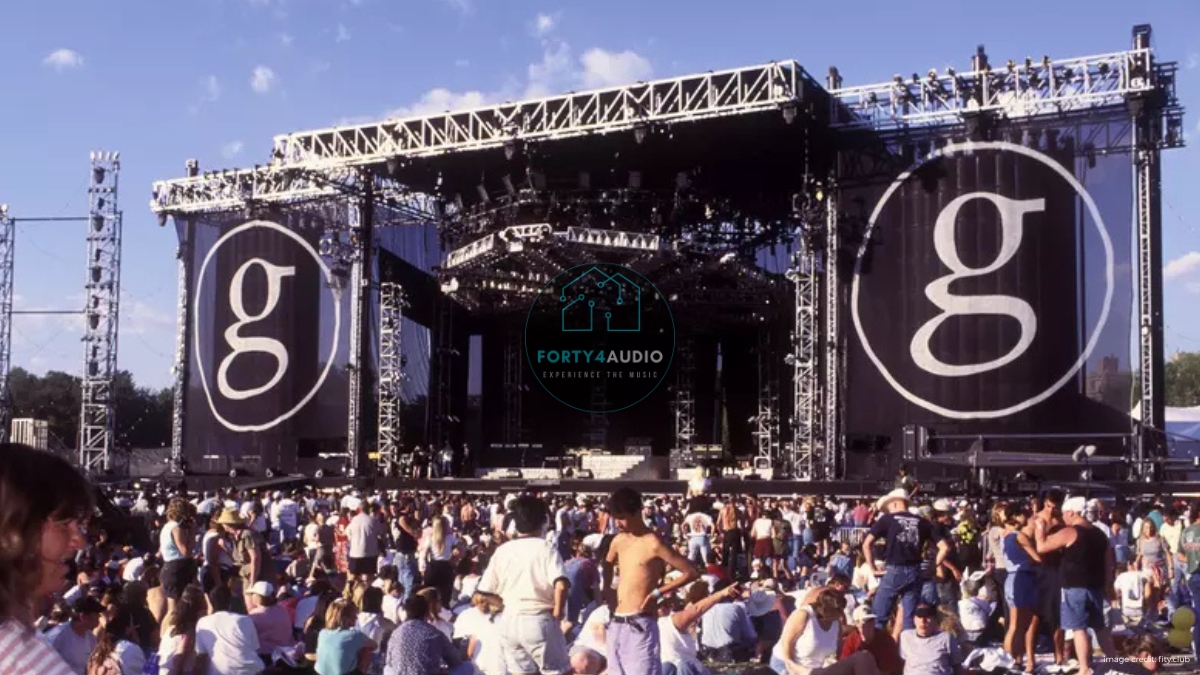
The air in a stadium is never truly empty. Before a single note is struck, there is a collective respiration – a shared waiting that exists in the space between the stage and the furthest seat in the rafters. When Garth Brooks released Double Live in late 1998, he wasn’t just capturing a series of concerts; he was bottling the specific, electric frequency of that shared breath. To listen to this album from beginning to end is to sit within that frequency, allowing the roar of thousands to become a textured, ambient layer of the music itself.
The 1990s were a decade of unprecedented scale for country music, and Brooks was the primary architect of that expansion. Yet, Double Live functions less as a trophy and more as a map of presence. It is a sprawling, two-disc document of a 1996–1998 world tour that redefined what it meant to be an entertainer. When we approach it today, removed from the frenzy of its record-breaking release week, we find a work that values the communion of the moment above the perfection of the studio.
The sequence begins with “Callin’ Baton Rouge.” It is a frantic, high-energy entry point that immediately establishes the hierarchy of the recording: the crowd is a primary instrument. The fiddle pulls the listener into the geography of the South, and the momentum is relentless. It transitions seamlessly into “Two of a Kind, Workin’ on a Full House,” a track that feels like the engine room of the set. Here, the interplay between Brooks and his band is tight, practiced, and yet brimming with the loose joy of a group that has spent years on the road together.
There is a shift in the atmosphere when the opening chords of “Shameless” emerge. This Billy Joel cover represents a pivot point in the early sequencing. It moves the listener from the rhythmic stomp of the honky-tonk into a space of vocal vulnerability. The way the audience anticipates the swell of the chorus creates a physical sensation of rising action. It is followed by “Papa Loved Mama,” which returns to a driving, cinematic narrative. The contrast between the soulful yearning of the former and the dark, driving humor of the latter is a testament to the emotional range required to hold an audience of eighty thousand people.
As the first disc progresses, “The Thunder Rolls (The Long Version)” arrives as a centerpiece. In the studio, this song was a masterpiece of atmosphere and restraint. Live, it becomes a literal storm. The inclusion of the “third verse” – the one famously omitted from the radio edit – gives the song a grit and a finality that feels essential in a live context. The rain effects and the heavy, brooding percussion create a wall of sound that demands a particular kind of focused attention. It is a song that changes depending on the volume at which it is played; at lower levels, it is a ghost story, but when turned up, it is a confrontation.
“We Shall Be Free” follows, providing a necessary breath of optimism. It serves as a secular hymn, a moment of collective aspiration that bridges the gap between the intensity of the previous track and the intimacy of what follows. That intimacy is fully realized in “Unanswered Prayers.” This is perhaps the moment where the “live” nature of the album is most profound. There are segments where Brooks stops singing entirely, letting the audience carry the melody. To listen to this in a quiet room is to feel the weight of thousands of individual stories merging into a single, whispered truth.
The pace quickens again with “Standing Outside the Fire,” a song built on a tribal, percussive heartbeat. It is an anthem of risk, and its placement here re-energizes the listener after the reflective lull of the ballads. This energy is carried into “Longneck Bottle,” featuring Steve Wariner. The inclusion of Wariner adds a layer of musical lineage to the album, a nod to the craftsmanship of the Nashville establishment that Brooks both honored and disrupted.
“It’s Your Song” and “Much Too Young (To Feel This Damn Old)” offer a look at the passage of time. The latter, Brooks’s debut single, carries a different weight in a live setting years after its release. There is a weariness in the delivery that feels earned. It leads into “The River,” another moment of high-concept metaphor that relies on the audience’s participation. The way the light must have looked in those stadiums during this song is etched into the audio; you can hear the stillness of the people.
The first disc closes with a trio of high-octane tracks: “Tearin’ It Up (And Burnin’ It Down),” “Ain’t Goin’ Down (‘Til the Sun Comes Up),” and “Rodeo.” These songs are designed for movement. “Ain’t Goin’ Down” is a linguistic feat, a rapid-fire delivery that feels like a tightrope walk. By the time “Rodeo” concludes, the listener is left with a sense of exhaustion and exhilaration, mirroring the end of a primary set before the depth of the second disc begins.
The second half of Double Live opens with “The Beaches of Cheyenne,” a tragic narrative that requires a reset of the listener’s emotional state. It is a mournful start to the final act. This is quickly balanced by the lighthearted, escapist spirit of “Two Piña Coladas.” The transition from a story of loss to a song of simple, tropical distraction reflects the reality of a long concert – and a long life. It is the ability to hold both grief and joy in the same space.
“Wild as the Wind,” featuring Trisha Yearwood, introduces a new texture of harmony. The chemistry between the two artists provides a focal point of genuine connection. It feels private, despite the scale of the venue. This sense of closeness is maintained through “To Make You Feel My Love.” Written by Bob Dylan, the song is stripped of any artifice here. It is a reminder that a great melody and a sincere delivery can make a stadium feel like a living room.
As we move toward the final stretch, “That Summer” brings a cinematic, nostalgic warmth. It is followed by “American Honky-Tonk Bar Association,” which acts as a populist anthem, celebrating the very people who populate the seats of the tour. The sequencing here is deliberate; it grounds the album in the identity of its audience before the final icons of the catalog are revealed.
“If Tomorrow Never Comes” is a cornerstone of the Brooks legacy. In this live iteration, the song feels less like a recorded track and more like a shared vow. There is a hush that falls over the recording, a digital preservation of a moment where everyone in the room was thinking of someone they loved. It is the ultimate “listening room” moment on a record of this scale.
The energy shifts one last time with “The Fever.” A cover of Aerosmith, it showcases the rock-and-roll DNA that Brooks injected into country music. It is loud, distorted, and physically demanding. It serves as the final peak before the inevitable descent.
Then comes “Friends in Low Places (The Long Version).” To hear this song live is to hear a cultural phenomenon in real-time. The “third verse” appears again, acting as a secret handshake between the artist and the fans. It is a song that has been heard a million times, but in the context of Double Live, it feels like the definitive version because it includes the reaction. It is the sound of a community claiming a song as their own.
Finally, the album reaches “The Dance.” There was no other way to end this work. It is the song that defines the philosophy of Garth Brooks’s career – the idea that the pain of the end is worth the beauty of the journey. As the final notes fade and the roar of the crowd slowly recedes into the distance, the listener is left in a profound silence.
Double Live is not just a collection of hits. It is a document of how music occupies space. It requires time to absorb because its scale is so vast, yet its most successful moments are its smallest ones – a cracked note, a shared laugh, the sound of a guitar string being dampened. It is an invitation to be present, to hear the way a voice changes when it is singing to people rather than a microphone.
When the record stops spinning, the silence that follows feels different than the silence that preceded it. It is a silence that has been filled, then emptied, leaving only the ghost of the thunder.