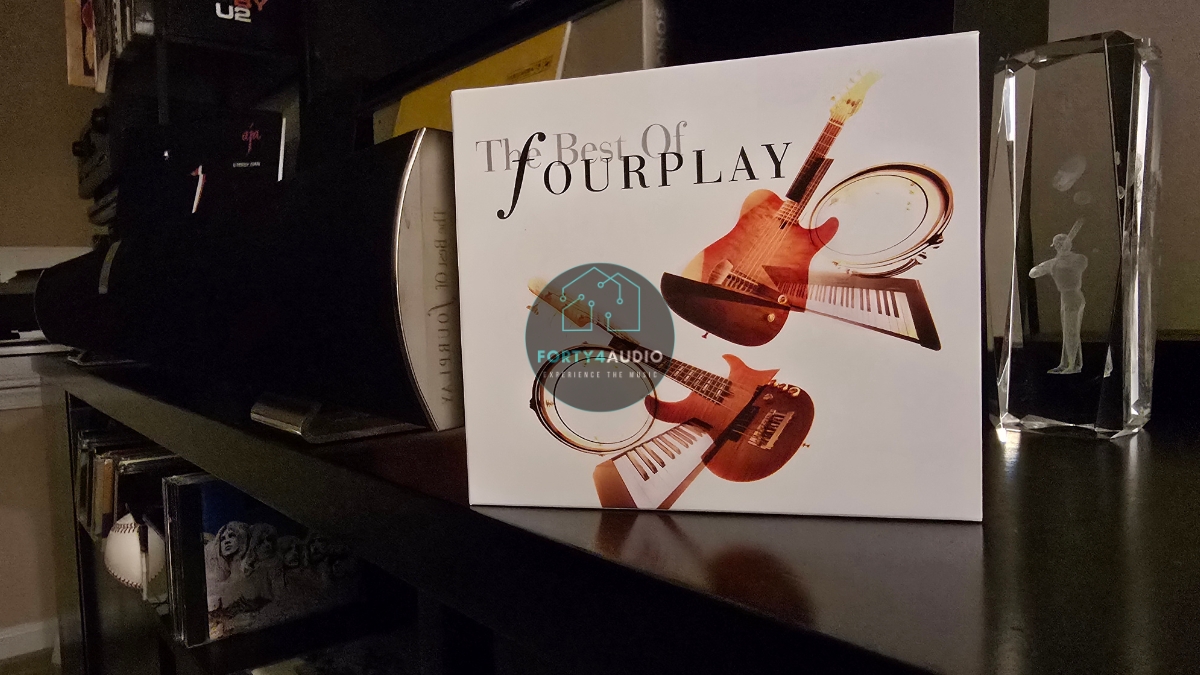
There is something quietly paradoxical about The Best of Fourplay – a compilation, by definition, resists wholeness. And yet this record keeps insisting on being heard as one. Not because it erases its origins, but because it reorganizes them.
The sequence matters here. The opening tracks do not announce themselves; they ease the room into a shared temperature. Keyboards settle first, then guitar, then bass and drums – no single voice rushing ahead. It feels less like a starting point and more like arriving mid-conversation, when everyone has already agreed on the pace.
This is where Fourplay reveals its long-running discipline: nobody is foregrounded for long. Bob James’ harmonic patience, Lee Ritenour’s phrasing, Nathan East’s melodic bass lines, Harvey Mason’s elastic sense of time – they rotate quietly, like light moving across a wall as the afternoon passes.
Because this is a compilation, the emotional arc is assembled rather than written – but that assembly becomes its own form of authorship. The transitions between instrumental pieces and vocal tracks are not abrupt. They breathe. When a voice enters, it does not feel like a guest appearance; it feels like the room briefly opening a window.
Chaka Khan’s warmth, Phil Collins’ restraint, El DeBarge’s softness, Take 6’s blend – these moments don’t interrupt the flow. They deepen it. Each vocal track feels placed to reset attention, to remind the listener of the human body behind the instruments, before the music slips back into wordless motion.
Repeated listening changes how the middle of the record behaves. Early on, it can feel like a gentle plateau – pleasant, even – but with time, small shifts emerge. A bass figure lingers longer than expected. A chord resolves sideways instead of forward. The drums pull back just enough to make the next entrance feel earned.
This is not music that asks to be understood quickly. It rewards familiarity, not analysis. The sequencing seems designed for that kind of return – for mornings that don’t need urgency, evenings that don’t want conclusions.
Near the end, the record does something subtle. The energy does not rise toward a climax; it thins. The final tracks feel lighter, more transparent, as if the album is slowly giving the room back to itself. Nothing is tied off. Nothing insists on being remembered in a particular way.
When the last notes fade, what remains is not a highlight reel, but a sense of having spent time somewhere calm and intact. Not finished. Just left open.
- “Max-O-Man” (written by Michael Lang, Harvey Mason)
- “101 Eastbound” (written by Nathan East)
- “Higher Ground” (New recording) (written by Stevie Wonder)
- “4 Play and Pleasure” (New recording) (written by Lee Ritenour)
- “Chant” (written by Bob James)
- “After the Dance” (written by Marvin Gaye, Arthur Ross, Leon Ware)
- “Bali Run” (written by Bob James, Lee Ritenour)
- “Play Lady Play” (written by Bob James, Lee Ritenour)
- “Between the Sheets” (written by Ernie Isley, Marvin Isley, O’Kelly Isley, Ronald Isley, Rudolph Isley, Chris Jasper)
- “Amoroso” (written by Harvey Mason)
- “Any Time of Day” (New recording) (written by Nathan East, Sam Purkin)
- “Why Can’t It Wait ‘Til Morning” (Remixed version) (written by Phil Collins)