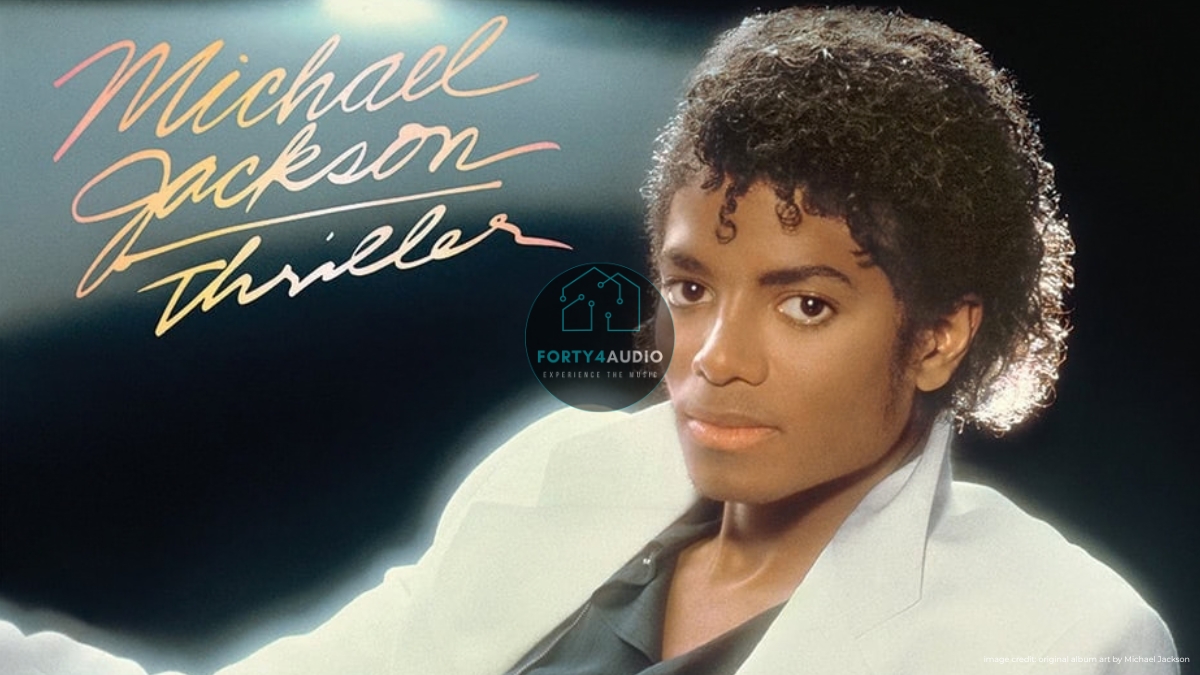
Some albums arrive as events. Others arrive quietly and stay.
Thriller by Michael Jackson has been talked about so much, in so many ways, that it can become difficult to approach it as a record again – as a sequence of sounds moving through time. But when the lights are low and the room is still, the album reveals itself not as a monument but as a carefully shaped arc of feeling.
Nine tracks.
Forty-two minutes.
A listening journey that moves from restless energy toward something softer and more reflective.
It begins with motion.
“Wanna Be Startin’ Somethin'” doesn’t ease the listener into the album; it drops you directly into momentum. The percussion feels alive from the first seconds – congas and drums layered with an almost restless pulse. Michael Jackson sings with urgency, the phrasing quick and playful but edged with tension. The groove is dense, almost crowded, and the chorus expands outward like a release valve.
Listen to how long the track breathes. It stretches past six minutes, allowing the rhythm to settle into the body. That chant near the end – “Mama-se mama-sa mama-coo-sa” – feels less like a lyric than a rhythmic circle the song falls into. As the opener, it establishes movement as the album’s starting condition: the world is loud, fast, and swirling with voices.
Then the room shifts.
“Baby Be Mine” glides in with warmth. Written by Rod Temperton, the song carries a softness that contrasts with the restless opener. The groove is lighter, the synthesizers gentler, the rhythm section moving with a quiet elegance. If the first track feels like stepping into a crowded street, this one feels like stepping into a private conversation.
Placed second, it allows the album to breathe. The romantic tone settles the pulse without losing momentum.
“The Girl Is Mine,” featuring Paul McCartney, arrives almost playfully after that. The arrangement feels spare compared to the surrounding tracks – acoustic guitar, gentle rhythm, voices trading lines back and forth. There is something theatrical about the dialogue between Michael Jackson and Paul McCartney, almost like a short scene unfolding between songs.
In the context of the album’s sequence, it provides a moment of levity. The energy relaxes. The voices lean toward humor rather than drama.
Then the record turns.
The opening synth line of “Thriller” feels unmistakable – moody, spacious, almost cinematic. By the time the bassline settles in, the album’s atmosphere has shifted from playful to mysterious. Rod Temperton’s composition builds patiently, stacking textures without rushing forward.
And then there is the spoken voice – Vincent Price’s famous narration – arriving like a ghost stepping into the room. But even beyond that moment, the song’s arrangement reveals something important about the album: Michael Jackson and producer Quincy Jones treat each track like its own environment.
Placed fourth, “Thriller” sits at the end of the album’s first side, acting almost like a threshold. Everything before it has moved between romance and rhythm. After it, the energy becomes sharper.
“Beat It” enters with a sudden burst of guitar and urgency. The drums snap into place, the tempo pushing forward. The rhythm is leaner here, more direct. Where earlier tracks layered percussion and synthesizers, this one cuts through with clarity.
Listen for the way Michael Jackson sings the verses – tight, controlled, almost restrained – before the chorus expands. And when the guitar solo arrives, it feels less like a break than a spark igniting the track’s tension.
Then the album shifts again.
“Billie Jean” may be one of the most recognizable openings in popular music: the steady drum pattern, the spare bassline, the quiet sense of suspense. But hearing it within the album reveals something different. After the intensity of “Beat It,” the groove here feels almost hypnotic.
Minimal. Focused. Patient.
The track moves with a slow, deliberate confidence. Each sound has space around it. Each line from Michael Jackson lands carefully within that space. It’s a moment where the album’s energy folds inward, becoming more psychological.
Side two begins to open outward again.
“Human Nature” arrives like cool night air. Written by Steve Porcaro and John Bettis, the song introduces a gentler emotional palette – soft synthesizers, floating chords, a melody that seems to drift rather than stride. The rhythm section becomes lighter, the textures more spacious.
After the darker mood of “Billie Jean,” the effect is calming. The city lights feel distant. The voice becomes softer, almost reflective.
Then comes a burst of brightness.
“P.Y.T. (Pretty Young Thing)” sparkles with playful energy. The synthesizers shimmer, the rhythm bouncing with a kind of carefree joy. Where earlier tracks carried tension or mystery, this one feels celebratory.
Listen closely to the background vocals and the layered harmonies – they give the track its lift. It feels like the album stepping briefly into pure light before its final moment.
Because the closing track moves differently.
“The Lady in My Life” slows everything down. The tempo relaxes. The arrangement becomes intimate – soft keyboards, warm harmonies, and a vocal performance that leans toward tenderness rather than spectacle.
Placed at the end of the album, it works almost like a quiet room after a long evening. The dramatic peaks have passed. What remains is warmth and closeness.
As the song stretches into its extended closing moments, Michael Jackson‘s voice becomes freer, improvising and layering emotion over the fading groove. The performance feels less structured, more like someone lingering in the room after the music has technically ended.
And in that lingering space, the shape of Thriller becomes clear.
The album moves from outward motion to inward reflection. From rhythm and tension toward warmth and stillness. Each track shifts the emotional feel slightly, allowing the listener to travel through different moods without losing the sense of a continuous arc.
Listening this way – letting the songs arrive in the order they were placed – reveals how carefully the record was constructed.
The final notes of “The Lady in My Life” don’t end abruptly.
They fade slowly, like lights dimming in a room that has held music for a while.